Last updated November 22, 2026
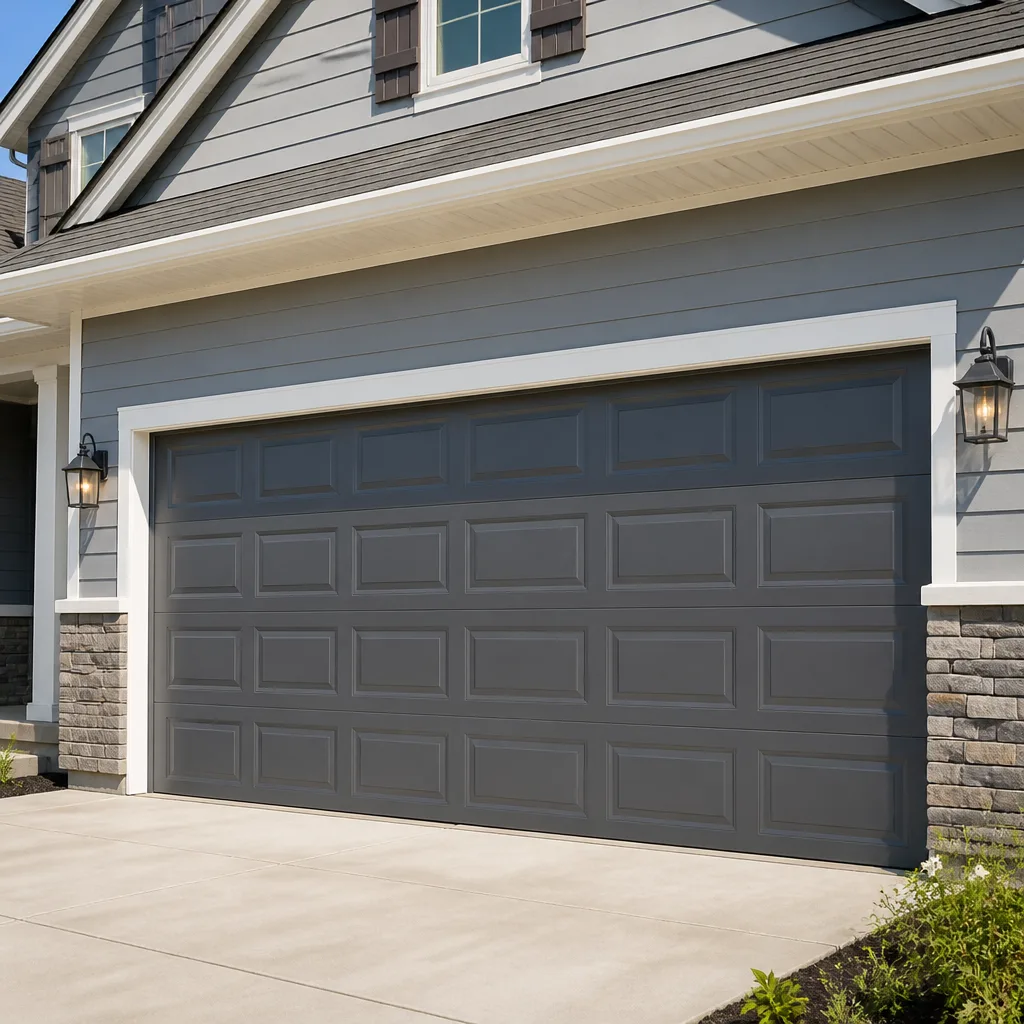 Raised-panel steel
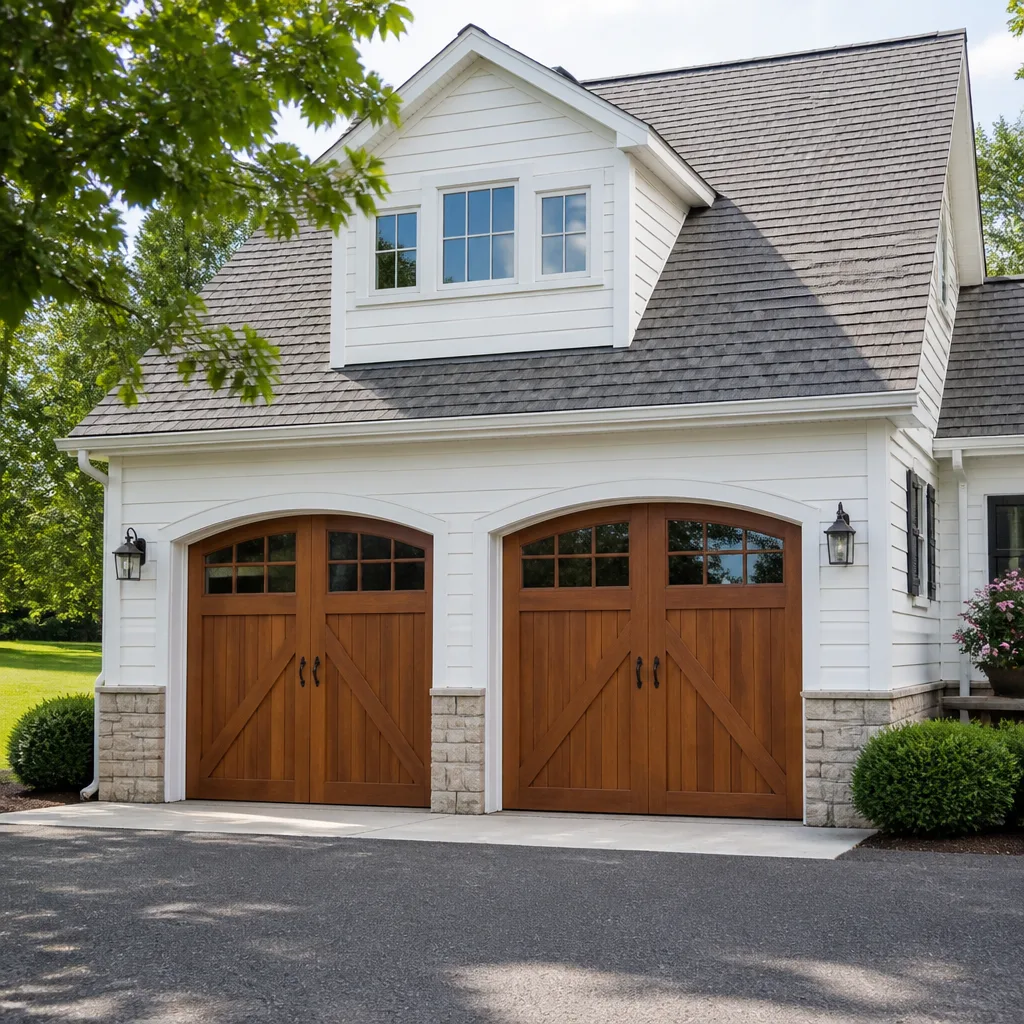 Carriage house
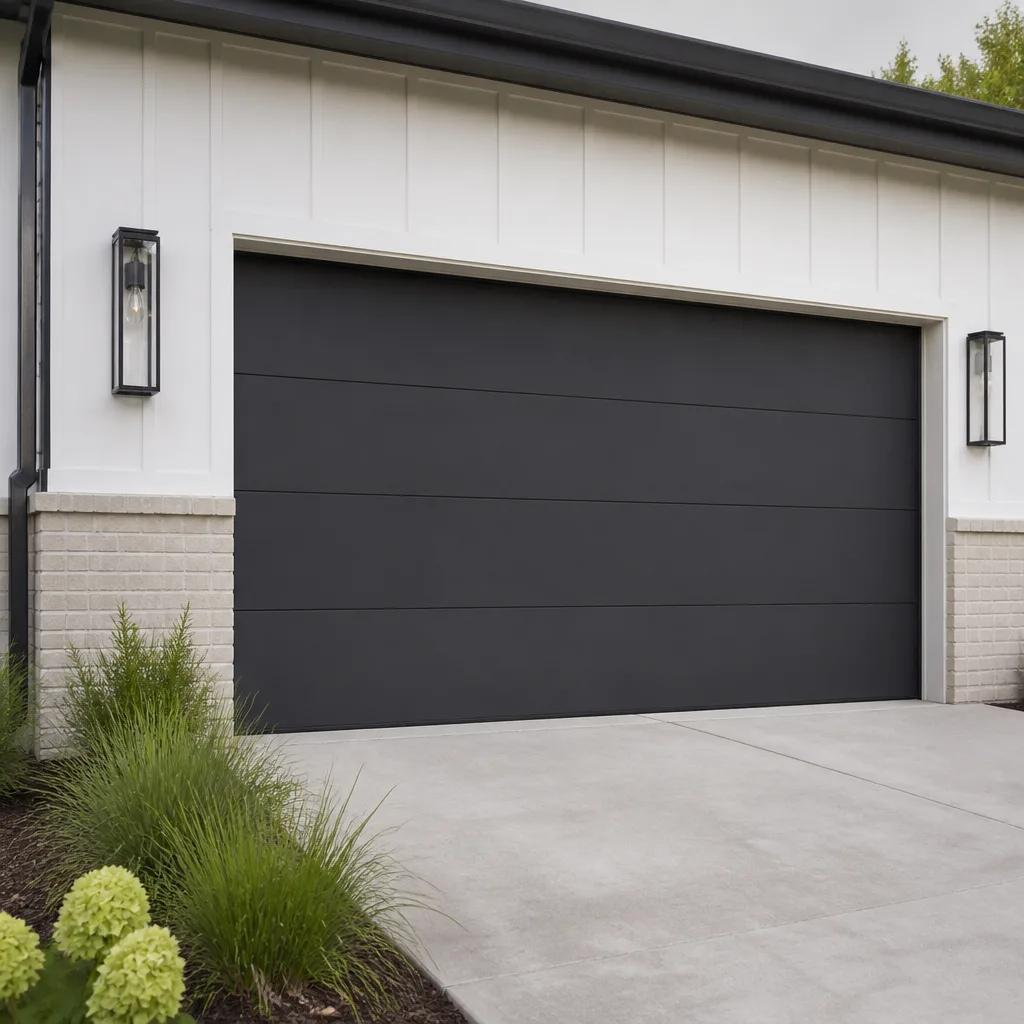 Modern flush
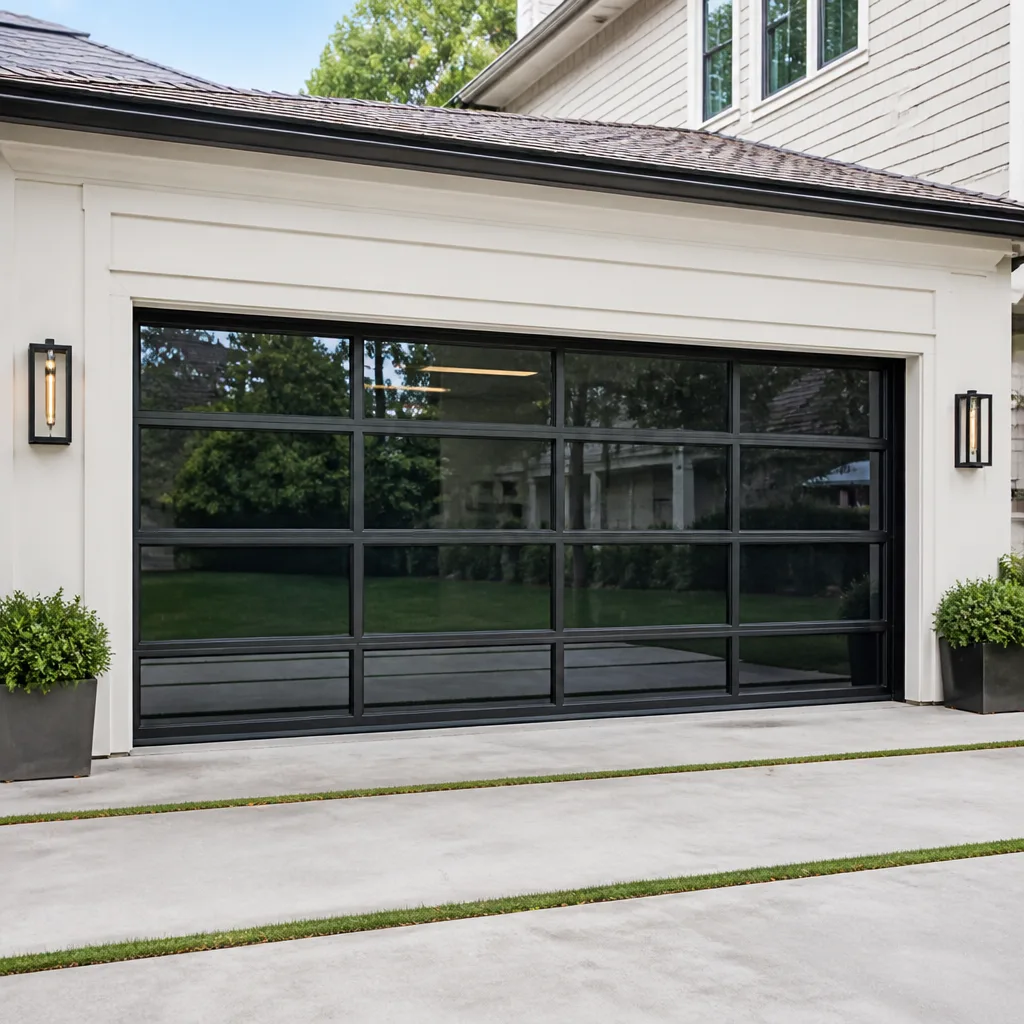 Full-view glass
 LiftMaster openers
 Chamberlain openers
Full 25-point door and opener safety check with every visit - springs, cables, rollers, tracks, and your LiftMaster or Chamberlain opener included
You get a price before we start. It does not change when the pro arrives.
Get your free estimateGarage Door Warning Signs: A Framingham Homeowner’s Reference Guide
That grinding noise your garage door has made for three months probably isn’t normal aging. It’s a specific mechanical signal, and it points to a specific part. Most homeowners in Framingham learn this the hard way: a door that squealed in November and groaned through February usually gives out on a morning when the car is loaded and the school run is already late. The parts involved don’t fail at random. They wear in a pattern, and they announce the wear first through sound, speed, and gaps you can see from the driveway. This guide walks through each of those signals, what it means mechanically, and how quickly you need to act on it. By the end you’ll know which signs are “watch this” and which are “stop using the door today.”
Quick Answer
Garage doors warn you before they fail through three channels: unusual sounds (squealing, grinding, popping), changes in how the door moves (slower, jerky, unbalanced), and visible problems (frayed cables, a gap in the spring, an uneven bottom seal). Popping followed by a door that won’t lift usually means a broken torsion spring and requires stopping all use immediately. Squealing or grinding typically signals worn rollers or dry hinges, which can be monitored for a short time. Cable fraying or a cable off the drum is an immediate stop-use condition because the door can drop.
Styles & brands we work with
- Raised-panel steel
- Carriage house
- Modern flush
- Full-view glass
- LiftMaster openers
- Chamberlain openers
Table of Contents
- The Sound Diagnostic: What Each Noise Tells You
- Visual Warning Signs Most Homeowners Walk Past
- Speed and Balance Changes as Early Warnings
- Signs You Can Monitor vs. Signs That Mean Stop Now
- How Long You Can Typically Wait on Each Warning
- What New England Weather Does to Garage Door Wear in Framingham
- Opener Warning Signs: When the Motor Is the Problem
- A Quick Monthly Check Any Framingham Homeowner Can Do
The Sound Diagnostic: What Each Noise Tells You
Garage doors are mechanical assemblies with a finite list of moving parts, so the number of distinct sounds they can make is actually small. Once you learn to map each sound to a component, the door tells you what’s wrong before anything breaks. We’ve worked on thousands of these systems across Framingham and the surrounding towns, and the noise-to-part mapping holds up almost every time. Here’s the sound-by-sound breakdown.
Squealing or High-Pitched Screeching
A squeal almost always comes from metal-on-metal friction at the hinges, rollers, or the torsion tube. The lubricant on those contact points dries out over time, especially after a cold winter. Squealing is annoying but usually not urgent, and it’s typically solved with proper lubrication and inspection of the roller bearings. If the squeal becomes a shriek that only happens at one section of the door’s travel, a roller may have seized.
Grinding
Grinding has a rougher, lower pitch than a squeal and usually indicates a worn or flattened roller, or debris in the track. It can also come from the opener’s gear assembly inside the motor housing, especially on older units. On a Craftsman or Chamberlain opener with a chain drive, grinding during the first and last foot of travel often means the chain is loose or the sprocket teeth are worn. Grinding is worth a service call sooner than squealing because a failed roller can score the track and turn a cheap repair into a track replacement.
Popping or a Loud Bang
This is the important one. A sharp pop followed by the door refusing to lift, or lifting an inch and stopping, is the classic signature of a broken torsion spring. A snapping sound from above the door, a visible gap in the coiled spring, and a door that suddenly feels very heavy all point to the same failure. Stop using the door the moment this happens. If you have an automatic opener, switch it to manual and leave the door down. A torsion spring under tension can be extremely dangerous if handled without proper training, and we strongly recommend keeping the door closed and calling for service rather than attempting anything yourself.
Rattling and Clanking
Loose bolts, worn hinges, or a panel with a loose fastener all produce a rattle that grows more pronounced through a given door’s travel. A rattle can also indicate the opener’s rail is loose where it mounts to the header, which puts stress on the motor over time. None of these are emergencies, but rattling is the most common precursor to a bigger failure if it’s ignored for a season or two.
Visual Warning Signs Most Homeowners Walk Past
Sounds get your attention. Visual wear barely does. Most of the serious failures we see on Framingham garage doors start with a visible condition a homeowner has walked past hundreds of times without registering it. A quick two-minute visual check from the driveway is worth more than any diagnostic app. Here are the four conditions worth knowing.
Cable Fraying
The lift cables run from the bottom bracket of the door up to the drum above the spring. They’re under tension constantly, and the strands at the drum end are the first thing to show wear. Frayed strands look like a small frayed rope where the cable meets the drum. Once one or two wires in the bundle have broken, the cable is carrying less load than it was designed for. A cable that fails entirely can whip unpredictably and drop the door. If you see fraying, treat it as a stop-use condition and get it inspected.
Spring Gap or Broken Coil
Torsion springs sit on a bar above the door. Extension springs run parallel to the horizontal tracks on either side. In both cases, a spring that has broken shows a visible gap of an inch or more in the coil. Sometimes the two halves of a broken extension spring hang loosely at the sides of the door. A spring gap is the most obvious visual sign on the whole door and the one most often missed because the spring lives above eye level. Look up.
Uneven Bottom Gap
Close the door and step outside. The gap under the bottom seal should be even across the width. If one side touches the ground and the other shows daylight underneath, the door is out of balance or one of the cables has stretched or slipped. Beyond the weather leak, an uneven door is putting more load on one side of the opener. That’s a repair that becomes a motor replacement if left.
Track Dents and Roller Wear
The vertical and horizontal tracks should be straight and their full width should be visible when the door is closed. A dent, kink, or twist in the track forces the rollers to fight the geometry on every cycle. Rollers themselves show wear as a flattened spot on the wheel, which you can see by watching the door in motion. If a roller looks flat rather than round, it’s due for replacement. This kind of wear is one of the most common reasons we get called for garage door repair after a small issue grows into a stuck door.
Speed and Balance Changes as Early Warnings
If sound and sight are the obvious channels, speed is the one that rewards attention. A garage door moving at a noticeably different pace than it did a month ago is telling you something specific.
Modern openers travel at a fairly constant speed in each phase: acceleration at the start, steady through the middle, and deceleration at the end. When a door slows down in the middle of its travel, the most common cause is friction building up in the rollers, hinges, or track. A door that speeds up then jerks or pauses is usually fighting a binding track or a failing bearing plate. A door that stutters at the very start of a lift cycle often has an opener issue rather than a door issue.
The Manual Balance Test
This is the single most useful diagnostic a homeowner can run safely. It takes about a minute and doesn’t require tools.
- Disconnect the opener by pulling the emergency release handle (usually a red cord hanging from the rail).
- Lift the door by hand to about halfway up.
- Let go gently.
- A balanced door will hold roughly in place. A door that drops fast, or that you can barely lift, is out of balance.
Out-of-balance almost always points to spring tension, cable tension, or a bent track. Don’t try to adjust the spring tension yourself. That’s a trained-technician job because the stored energy in the spring is significant. But running the balance test monthly is one of the best things you can do to catch a problem early. Reconnect the opener when you’re done by re-engaging the trolley; the opener’s manual explains the exact step for your model.
A door that jerks or shudders in motion is also telling you about the opener, not just the door. If you hear a repeated click and a shutter at the same travel point every cycle, your garage door opener repair visit will confirm whether it’s a worn gear, a mis-set travel limit, or a failing logic board.
Signs You Can Monitor vs. Signs That Mean Stop Now
The useful distinction in all of this is not “big problem” vs. “small problem.” It’s “keep using the door while you schedule a service” vs. “stop using the door today.” Getting that wrong in either direction has real costs. Ignoring a stop-now sign can turn a repair into a door replacement. Treating every squeak as an emergency leads to panic calls and unnecessary work. Here’s the split we use.
Monitor These Signs
- Squealing or light grinding from a single point in the door’s travel
- Rattling that comes and goes
- Minor cosmetic wear on rollers (flattening but not seizing)
- Opener running slightly louder than it used to
- A sluggish wall-mounted control or a remote with a faded battery
None of these are going to drop the door on you today. Schedule a service visit within the next couple of weeks and mention the specific symptom when you call. If a monitored sign changes character, escalate to a stop-now sign immediately.
Stop-Now Signs
- Broken torsion or extension spring (visible gap, loud pop, door won’t lift)
- Frayed or separated lift cable
- A cable that has come off the drum
- Door that has come off the track entirely
- Door stuck open and won’t close at night
- Opener that runs but the door doesn’t move (see opener note below)
For any of these, leave the door alone and call for service. The door is holding stored energy in the spring or supporting its weight on a stressed cable, and the safe action is to keep people and vehicles clear of it. If the door is stuck open and won’t close, that’s a home security situation as well as a mechanical one, and the emergency side of a garage door service is the right call.
How Long You Can Typically Wait on Each Warning
Homeowners ask us this constantly, and the honest answer is that the timeline depends on how much load the door sees per day, plus how far the wear has already gone. That said, there are reasonable ranges to work from. Use these as a rough urgency guide, not a guarantee, and let the technician confirm when they’re on site.
Squealing or surface grinding
Weeks to a few months. This is usually a lubrication and roller issue. Wait for a convenient week, but don’t let it run a whole season. The wear compounds, and what starts as a squeak becomes a roller replacement.
Out-of-balance door detected by the manual test
A couple of weeks. Out-of-balance accelerates wear on the opener and the rollers because both are constantly compensating. Get it looked at before it forces a bigger repair.
Spring fatigue (door feels heavier but still lifts)
A few weeks. Torsion springs lose tension gradually, and a door that has become noticeably heavier on the manual test is approaching the end of its spring’s life. On a Raynor or Clopay door that’s in daily use, spring fatigue usually shows up before the spring actually breaks. Replacing a tired spring on your schedule is far less expensive than dealing with a break that strands you.
Broken spring
Now. Not tomorrow. Not after the weekend. The door is not safe to operate, and the springs are holding trapped energy. This is the point where a routine service call would have been the cheaper option.
Frayed cable
Now. A cable that is down to a single strand is close to releasing under load, and when it does the door can drop on one side. This is one of those failures we treat as pure urgency, not convenience.
Door off track or stuck open
Now, and consider it an emergency call if the door is stuck open or blocking a vehicle.
What New England Weather Does to Garage Door Wear in Framingham
Framingham sits in a climate that swings hard across the year: humid summers, deep freezes in January and February, and freeze-thaw cycles in between. That pattern shapes which garage door parts wear fastest here compared with warmer or drier regions. It also makes the warning-sign vocabulary slightly different in Framingham.
Winter condensation and hinge corrosion
Every time a warm garage meets cold outside air (or the reverse), you get condensation on the metal parts. Over a winter, hinges and the bottom bracket of the door will rust faster in a Framingham garage than in a dry climate. That rust shows up first as that grinding you hear in February and March. Lubrication before the first hard freeze does more for the door than anything you do in the spring.
Freeze-thaw on the bottom seal
Any moisture on the driveway that gets under the bottom seal and freezes will stress the seal and can pull it away from the door bottom. That’s often the source of the “uneven bottom gap” you notice in the spring. If you see the seal separating at one corner, it’s usually the seal, not the balance, but it’s worth checking both.
Expansion on hot days
In July and August, metal tracks expand slightly. Doors that were whisper quiet in April can start to rattle in July because clearances that were tight have grown. A lot of people call us in summer for a noise that we trace to a small track adjustment. This isn’t a failure, just normal thermal movement, but it’s easier to fix while it’s small.
Road salt spray on the door panels
If you park a wet car in the garage and the door is down, the salt spray evaporates into the air and settles on the bottom panel and threshold. That accelerates corrosion on the bottom section and lower tracks, especially on steel doors. Wiping down the bottom panel a few times each winter helps, and it’s a good reason to check the bottom seal and lower track closely each spring.
For homeowners in Framingham who are weighing repair vs. replacement after a winter of warning signs, the honest conversation is worth having before the next hard frost. A door that’s been patched through three winters is usually better replaced than patched a fourth time, and the estimate for a garage door installation is often closer than people assume. Getting a free measure and written quote lets you decide on the real numbers instead of guessing.
Opener Warning Signs: When the Motor Is the Problem
About a third of the calls we take in Framingham turn out to be an opener issue rather than a door issue. The door itself is fine; the motor, chain, belt, or logic board is the failing part. The opener’s warning signs overlap with the door’s, but they have their own specific vocabulary.
Reverses on its own mid-travel
A door that goes up three feet and then reverses without hitting anything is usually tripping the safety sensor or the force limit. The sensors at the bottom corners of the track have a small lens that dust, cobwebs, or a shifted bracket can interfere with. If cleaning and aligning the sensors doesn’t resolve it, the opener’s force setting is probably too sensitive, which is a technician adjustment.
Runs but the door doesn’t move
If you hear the motor run but the door stays put, the trolley has disconnected (sometimes from a manual release that wasn’t re-engaged) or the drive gear inside the unit is stripped. On a Chamberlain or LiftMaster belt-drive in a Framingham home that’s more than a decade old, a stripped gear is the most common cause. The opener needs service, but the door is fine, and that’s a low-drama repair once it’s diagnosed.
Slow response to remote or wall control
Remotes on their last battery, wall controls with a loose wire, or a logic board that’s losing its programming all produce a sluggish or intermittent response. Replace the remote battery first because it’s the easiest fix. If the wall control is also slow, it’s the opener, not the remotes.
Loud operation, especially at the start
Chain drive openers get louder as the chain wears. A belt-drive is quieter by design, but the belt can dry out or lose tension over time. If the opener has become noticeably louder than it was a year ago, the mechanical side of the opener needs attention. This is the sort of thing that a maintenance visit catches before the opener fails entirely.
One note worth making: an opener that “still works” is not the same as an opener that’s safe. Older units without modern safety reverse (or with a malfunctioning reverse) can trap a person or a pet under a closing door. If your opener is very old and its reverse test fails, replace it. That’s not a scare tactic, it’s a real safety issue, and any trained technician will say the same.
A Quick Monthly Check Any Framingham Homeowner Can Do
You don’t need to be mechanically inclined for this. The whole check takes under ten minutes and catches most of the warning signs covered in this guide. Run it once a month, ideally on the same weekend each month so it becomes a habit.
- Listen at the start. Open the door from closed and pay attention to the first two seconds. Any new noise?
- Watch the travel. Does the door move evenly, or does it jerk, slow, or stutter at any point?
- Close and look at the gap. From outside, check the bottom seal for daylight at either end.
- Glance at the springs. Look up. Any visible gap in the coil, or does anything look loose?
- Check the cables where they meet the drum. Look for fraying near the top corners.
- Run the balance test. Pull the release, lift the door halfway, let go. It should hold roughly in place.
- Test the reverse. With the door closing, wave an object across the safety sensors. The door should reverse.
- Note anything new. Write it down or photograph it. When you call for service, “squeal from the left hinge, second panel from bottom” gets you a faster diagnosis than “the door is loud.”
Any sign that lands in the stop-now category from earlier in this guide, jump to calling for service. Everything else, schedule the visit and keep the list handy. If you’re not sure where a sign falls, call and describe it. A quick phone conversation sorts out whether it’s a “this week” or a “this month.”
Common Mistakes to Avoid
- Lubricating the tracks. Tracks are supposed to be clean and dry so the rollers roll along them. Lubricant on the track turns it into a slide and makes the door harder for the opener to push. Lubricate hinges, rollers, and springs (per manufacturer guidance), not the tracks themselves.
- Trying a torsion spring repair yourself. This is the single most dangerous DIY attempt on any garage door. The spring holds stored energy, and the tools required to wind and unwind it are not homeowner tools. Leave spring work to a trained technician. If you’ve ever wondered why every garage door tech says the same thing, it’s because springs cause real injuries.
- Ignoring a broken spring and running the opener anyway. The opener can often pull a broken-spring door up a few times before burning out its motor. That’s an expensive lesson. A door that suddenly feels twice as heavy means stop.
- Assuming noise is just old age. In Framingham’s freeze-thaw climate, noise is almost always a specific worn part that could have been caught. The assumption that “old doors are just loud” lets small issues run until they’re expensive ones.
- Forcing a stuck door by hand. Lifting or pulling a stuck door by hand can bend the panels, kink the track, or (worst case) drop the door on you. A stuck door is a call, not a push.
- Replacing the whole door when one panel or hinge is the issue. Cosmetic damage is often local. Get a specific estimate before assuming a full replacement is needed. Conversely, an out-of-balance door that’s been adjusted three times is a candidate for replacement rather than a fourth adjustment. Have the conversation either way.
- Skipping the balance test because the door “works.” A working door that’s quietly out of balance is doing double wear on the opener. The balance test takes a minute and is the cleanest early-warning diagnostic you have.
See the difference
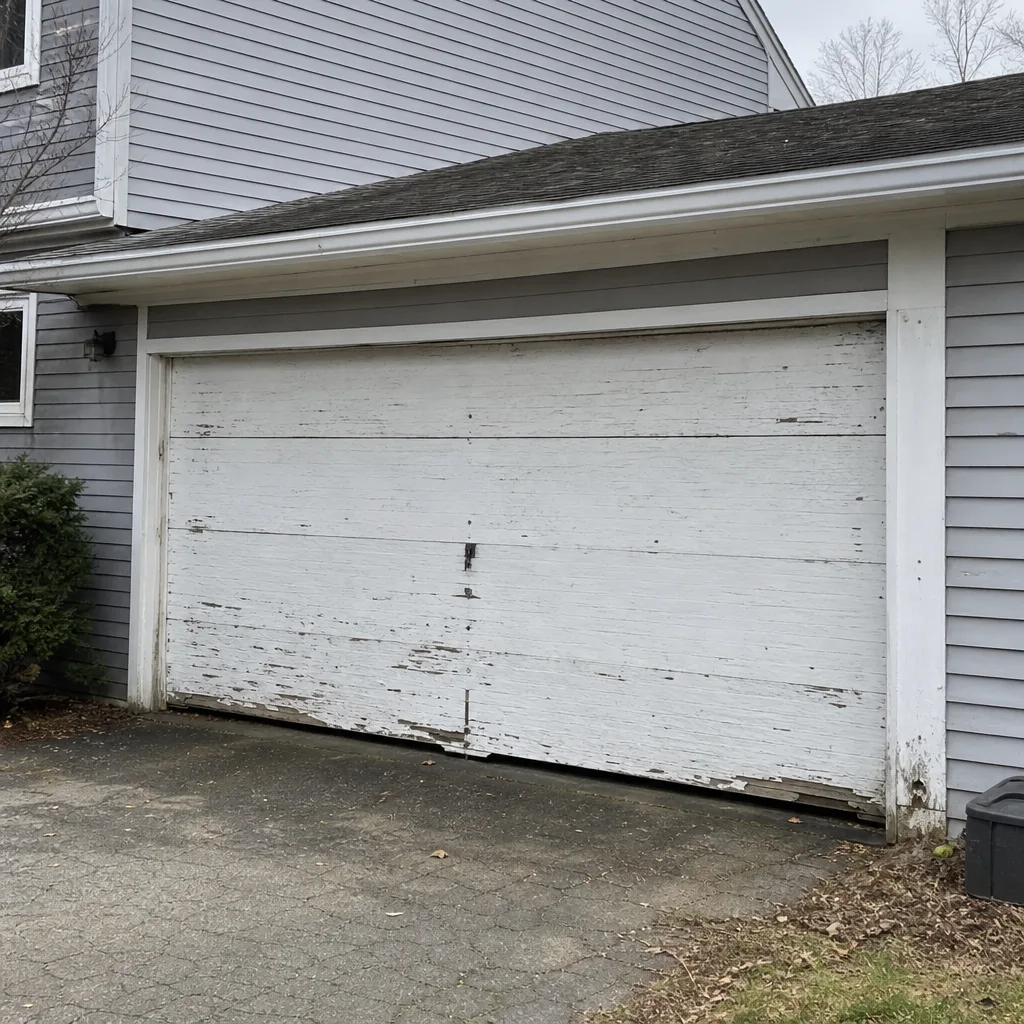 Before
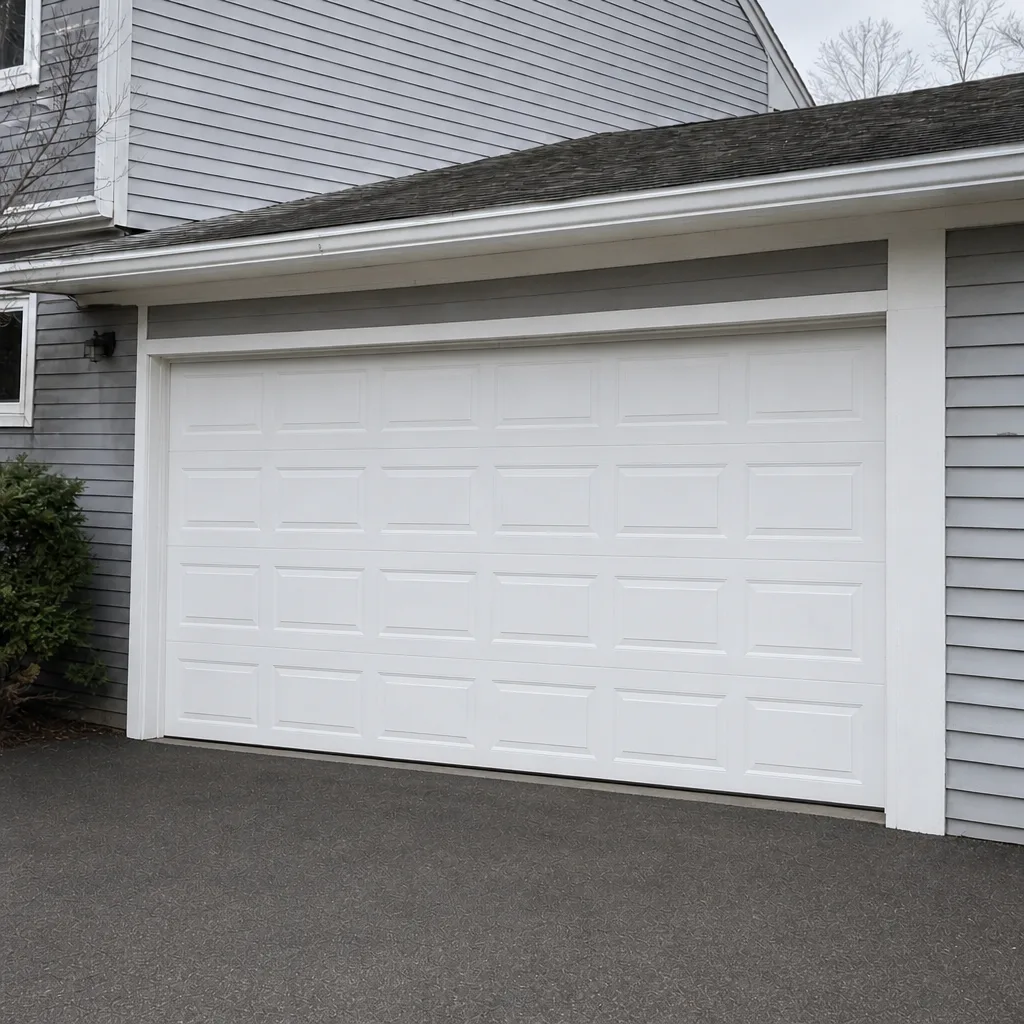 After
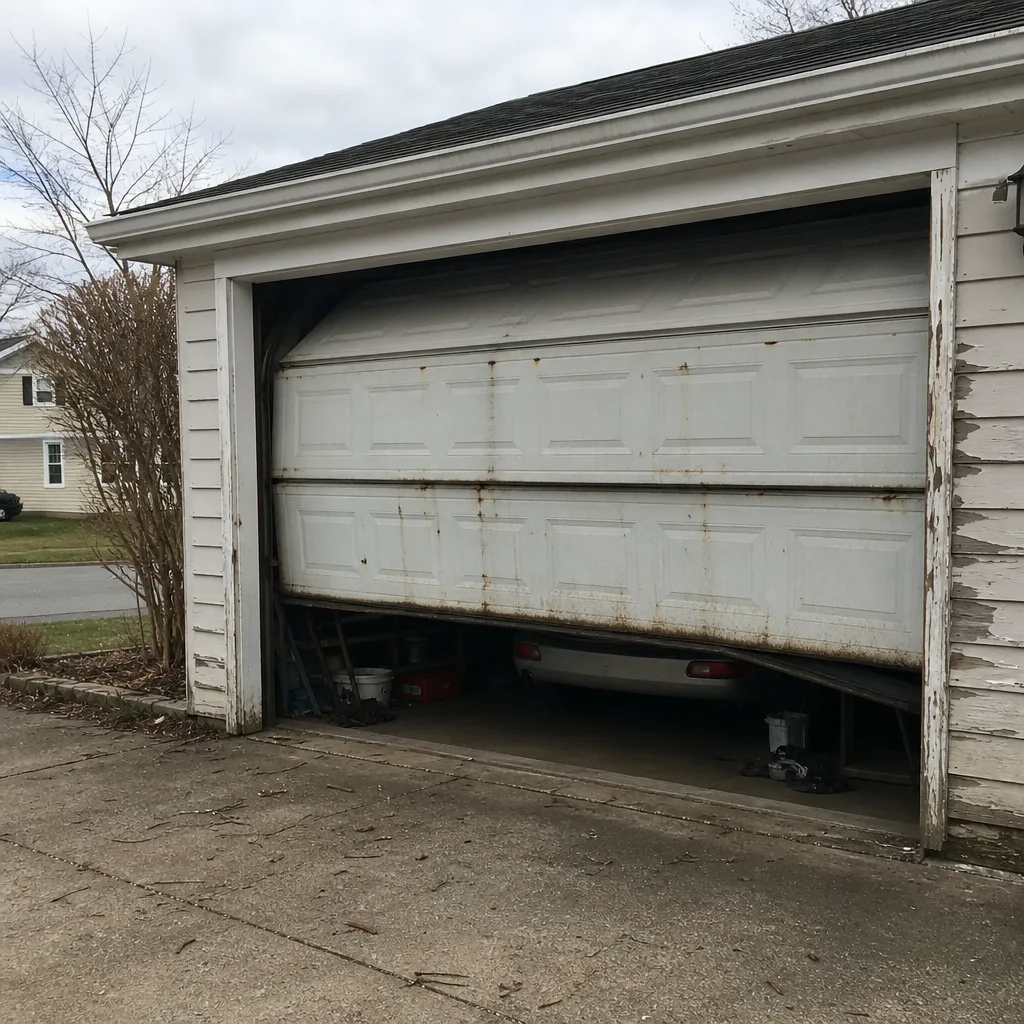 Before
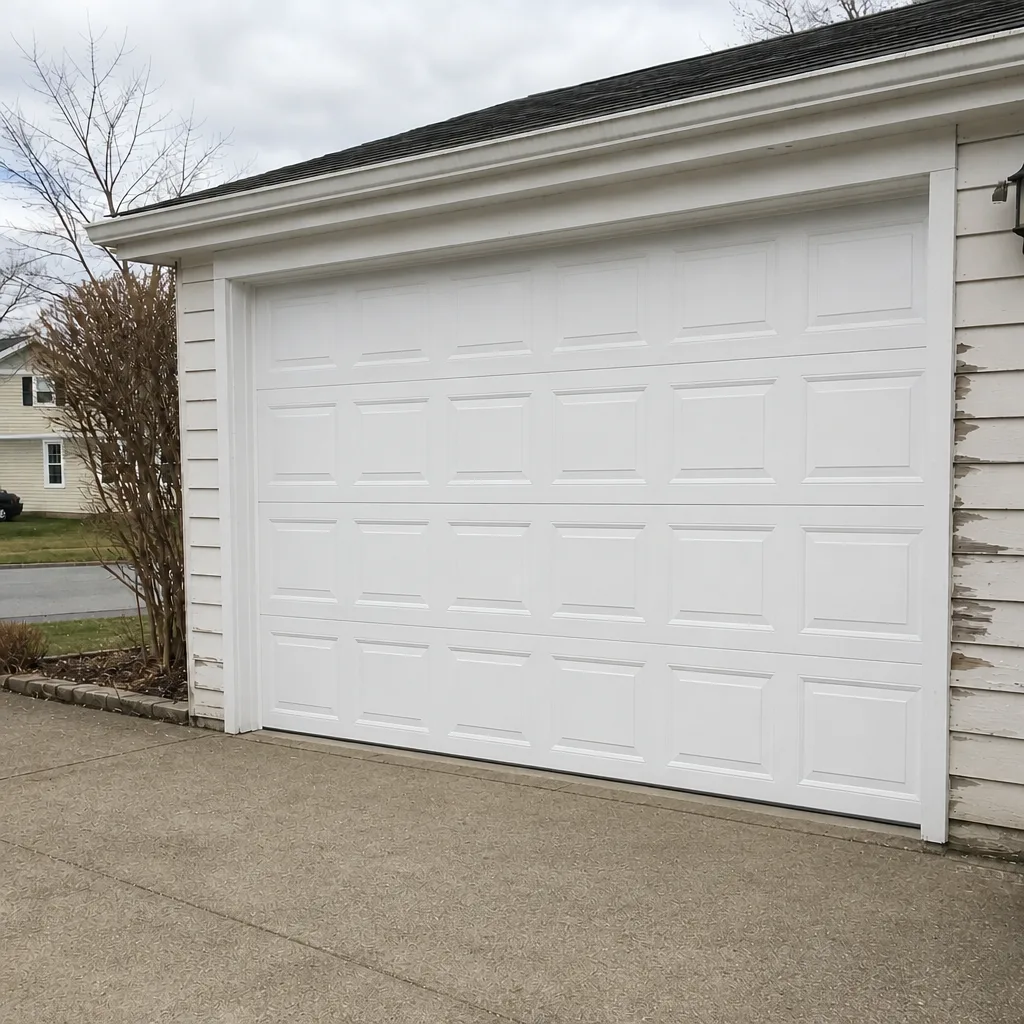 After
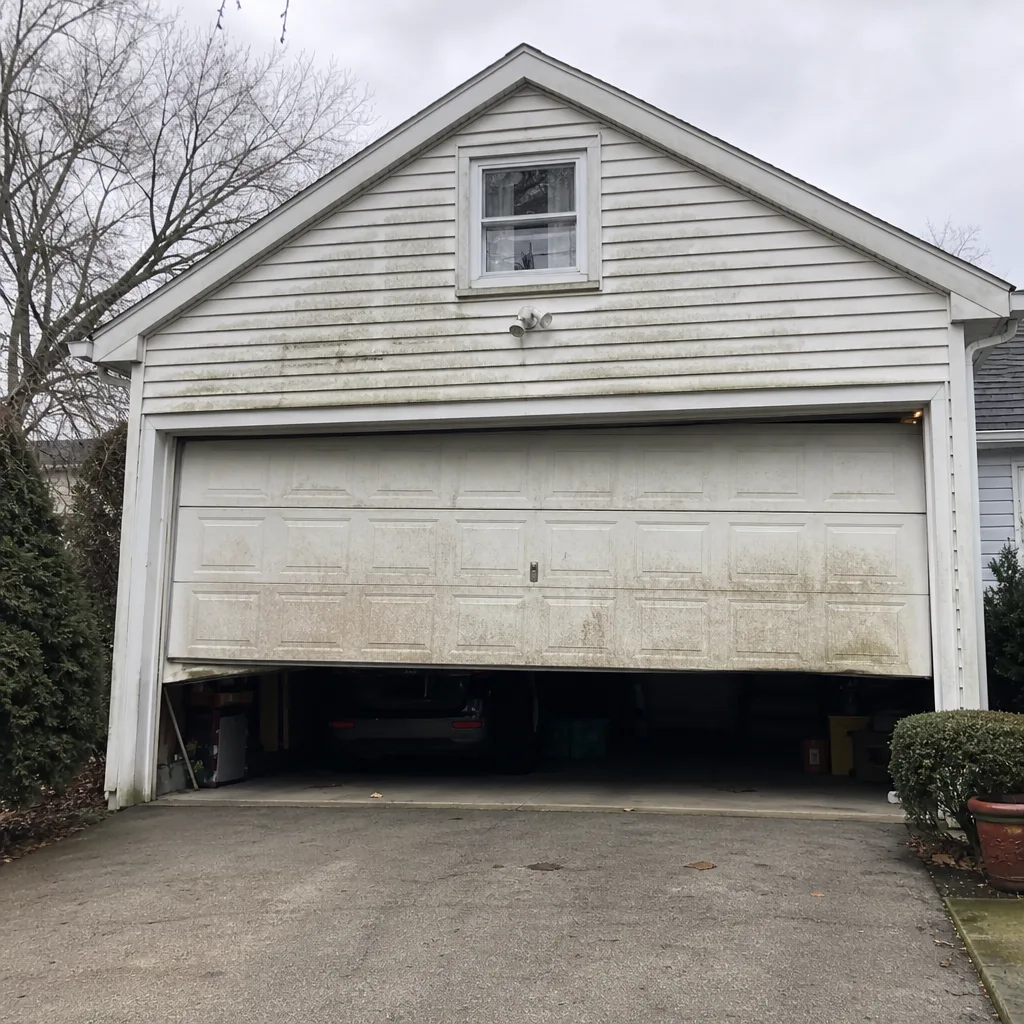 Before
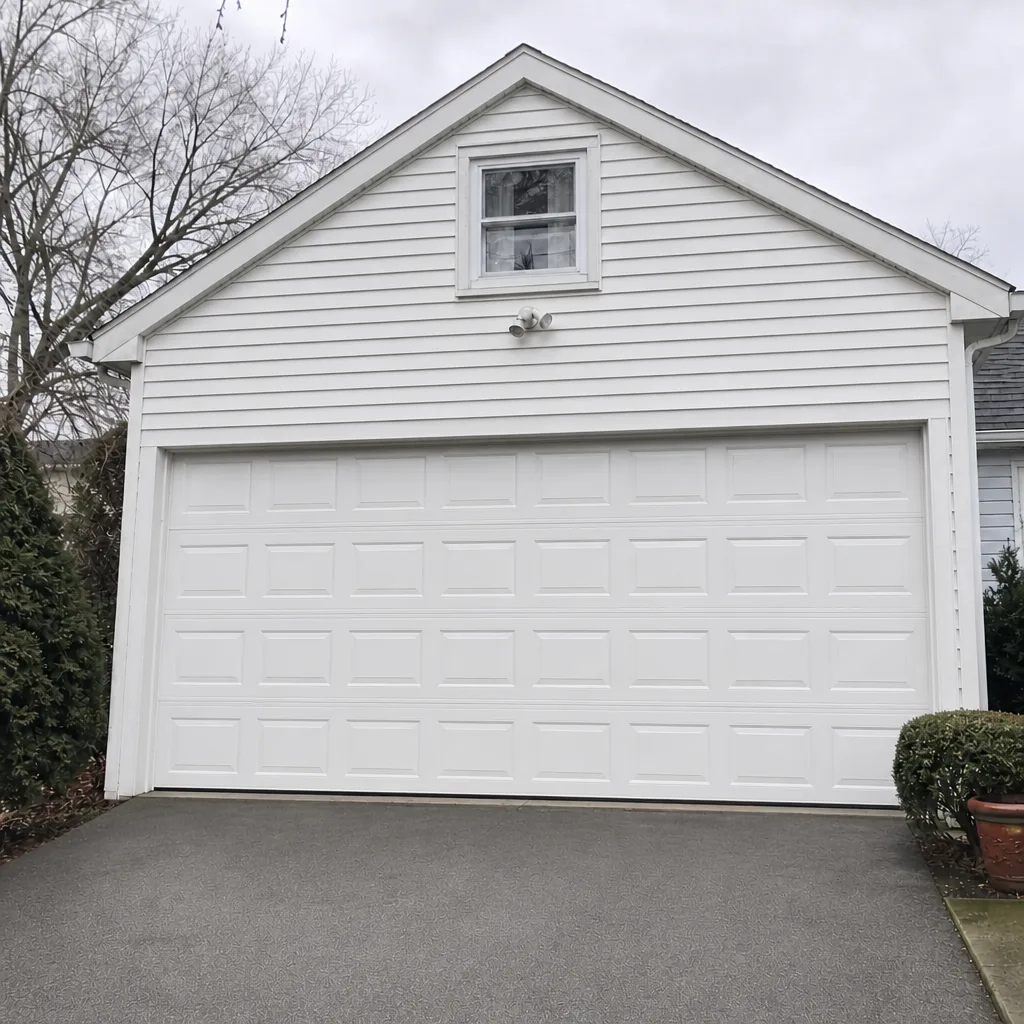 After
When to Call a Professional
Call a professional for anything involving springs, cables, or the opener’s internal mechanics. Those components either store significant energy (springs, cables) or require model-specific knowledge (opener logic boards and travel limits). The safe rules are simple: any broken spring, any frayed or off-drum cable, any door off track, any door stuck open at night, or any opener whose safety reverse isn’t working. Also call if a monitored sign hasn’t improved in two or three weeks, because that’s the window where a small fix stays small.
Framingham Garage Door Repair Pros offers free estimates in Framingham. Call (877) 665-1930 to talk through what you’re seeing or hearing. We work exclusively on garage doors, so the person on the other end of the phone does this every day. Our technicians have up to 12 years of experience, they work on LiftMaster, Chamberlain, Craftsman, Raynor, and four other common brands, and they’ll give you a written estimate before any work begins.
Frequently Asked Questions
A loud popping noise from a garage door usually means a torsion spring has broken. Look above the door for a visible gap in the coiled spring, then try the manual lift test (release the opener and lift by hand). If the door feels very heavy or won’t lift at all, stop using it and call for service. A spring break is the most common serious garage door failure, and it’s not something to test by trying the opener again. Call (877) 665-1930 for a free estimate on the repair.
Yes, briefly. Squealing usually points to dry hinges or a worn roller, and it’s not going to drop the door on you today. But it accelerates wear on the parts making the noise, and in Framingham’s winter climate that wear speeds up. Schedule it within a few weeks rather than letting it run a full season. If the sound becomes a hard grind or a shriek, treat it as more urgent.
Run the manual test: pull the emergency release on the opener, lift the door to about halfway, and let go. A balanced door holds roughly where you left it. A door that drops fast, or that you can barely lift, is out of balance. Don’t attempt to adjust the spring tension yourself; that’s a trained-technician job. Call (877) 665-1930 to schedule a balance check and any adjustments you need.
Absolutely, and it happens often. Once a torsion spring breaks, the door can look normal from the street and even lift an inch or two before stopping. Frayed cables can also stay hidden behind the spring until you specifically look up at the drum. That’s why a two-minute visual check of springs and cables is worth doing monthly, not just when something sounds wrong.
Leave the door alone and call for service. A door stuck open is a security situation as well as a mechanical one. Don’t try to force it down by hand, because if a cable or spring is the cause, a forced close can make the failure worse and put you in the path of a falling door. Reach out for after-hours garage door service rather than waiting for the next business day, especially if the garage provides access to the home.
Not on the line items you agreed to. The technician diagnoses the issue on-site, tells you what needs to be done, and quotes the job in writing before starting any work. If the diagnosis turns up something that wasn’t obvious on the phone, you’ll hear about it before any additional work is done, and you can decide whether to go ahead. Nothing gets done without your yes, and the estimate you agree to is the price you pay for the agreed work. Call (877) 665-1930 for an exact quote. Estimates are free.
The Bottom Line
Your garage door announces most of its failures well before they happen. Squealing and grinding map to specific parts you can service on your schedule. Popping, broken springs, frayed cables, and doors off track are stop-now signals that require a service call, not a wait-and-see. The manual balance test once a month catches more problems than any other five-minute habit, and Framingham’s freeze-thaw climate makes the December-through-March window the most important time to pay attention. If you’ve been hearing the same noise for three months, it isn’t normal aging. It’s a specific mechanical signal, and calling early is always cheaper than calling after the door has failed. When you’re ready to sort it out, the team at (877) 665-1930 is here to help. You can also start from our Framingham Garage Door Repair Pros main page for the full range of what we do.
Written by the team at Framingham Garage Door Repair Pros.